Your Booking Season Marketing Doesn't Start in November
Booking season marketing doesn't start when engagements spike in November—it starts in September, with the prep work most wedding pros skip until it's too late. This guide breaks down a four-phase booking season marketing timeline, from foundational September prep through a repeatable content calendar, so you know exactly what to do and when.
Here's a hot take I've been serving up to rooms full of wedding pros lately: if a couple came to you in October asking you to pull off their wedding by November, you'd laugh, gently explain that's not how any of this works, and start talking timelines.
So why do you do that to yourself when it comes to marketing your wedding business during booking season?
Every year, booking season "starts" the moment engagements spike (right around the Thanksgiving holiday). And every year, a huge chunk of wedding pros treat that spike like the starting gun instead of what it actually is: the finish line of work that should've happened months earlier.
Because you have the skills to plan a multi-month timeline with a whole lot riding on getting the order of operations right. You use them for your couples constantly. You're just not pointing them at your own business.
So that's what this is about. Because booking season doesn't start in November. It starts in September. Yes, I know that's an absurdly busy time of year to ask you to think about this. But I'm asking anyway.
The Mistake Almost Every Wedding Pro Makes
After more than a decade working closely with wedding pros, I've watched the same pattern play out over and over: booking season arrives, you expect inquiries to start picking up, and your reaction is to post more. More Reels, more captions, more everything, all at once, usually starting the week engagement season is already underway.
Which is stressful twice over—once because you're behind, and again because "post more" isn't actually a strategy. It's a panic response.
But the wedding pros who have the smoothest, most successful booking seasons aren't doing more. They're doing something different: they know that volume isn't the lever—timing and message are. It's not about getting louder. It's about saying the right thing, to the right person, at the right time. And that requires a plan you built before you needed it.
So let's build one. A phase-based approach to booking season, using the exact project-management instincts you already trust with everyone else's wedding day.
Phase 1: The Foundation—September
This is the work nobody sees. It's also the work that decides whether everything after it actually works. Budget about six hours here even though I know that sounds like a lot in a month that's already packed. But stick with me.
And here are the things you can do.
Update your customer personas(budget: 1 hour) No, I don’t care about whether they are a dog or cat person. I want you to sit down and think about what gets them to do or not do something because that is your ultimate goal.
What do they struggle with?
How do you solve it?
What are their psychographics?
What's making them look for someone like you, right now?
What do they want?
What do they need to see, hear, and feel to get there?
Update your packages and pricing(budget: 1 hour)
Are your services actually what your ideal couple wants?
What "never again" moments from this past season should shape what you offer next?
Is your pricing profitable?
Do a brand and website audit(budget: 4 hours)
Is your brand consistent everywhere, visually and in your messaging?
Does your website actually speak to your ideal couple?
Does it give them the information they need (yes, that includes some form of pricing)?
Does everything work? Links, forms, buttons—check it all.
Six hours now versus starting all of this the week before Thanksgiving. I'll let you do that math and think about what your calendar is gonna feel like.
Phase 2: The Set Up—October
Now you start building up on solid, strategic ground. This phase runs about eight additional hours, and if you skipped Phase 1, you're not doing eight hours in October, you're doing fourteen, in a month that's rapidly closing in on peak season in addition to being the most popular month to get married. Don't do that to yourself.
Push for new reviews Ask past couples for reviews but give them better questions than "how was everything!" Try:
What almost didn't happen without us, and how did we handle it?
What would you tell a couple who's nervous about [the thing you specialize in]?
What's something about working with us that surprised you?
Also ask if they'd be willing to record themselves talking for a few minutes. You don't need polished video—audio over b-roll works great, and it's some of the most compelling content you'll post all season.
Update your old, well-performing blog posts Find the posts already bringing you traffic and make them work harder:
Beef up the word count to 1,000+
Add a TL;DR intro
Add an FAQ section
Update any outdated info
Add a testimonial and/or internal links
Update the publish date and resubmit to Google Search Console
Plan your content calendar Budget about an hour of planning per month, plus the time to actually create it (more on exactly how to structure this in a minute). One stat worth sitting with: wedding pros who go into booking season with an actual content plan are three times as likely to follow through on it. Why? Because they're not trying to build the plane as they fly it.
Phase 3: The Execution—November Through February
This is go time. And what shifts here is the sheer number of things your marketing needs to accomplish at once—couples need to find you, get curious, and actually inquire, all while you're also, you know, working weddings.
And I want to be clear about something before we go further: posting more still isn't the goal. The goal is getting someone to do something. Those are not the same objective and treating them like they are is how you end up exhausted with a content calendar full of noise and an inbox that isn't filling up any faster.
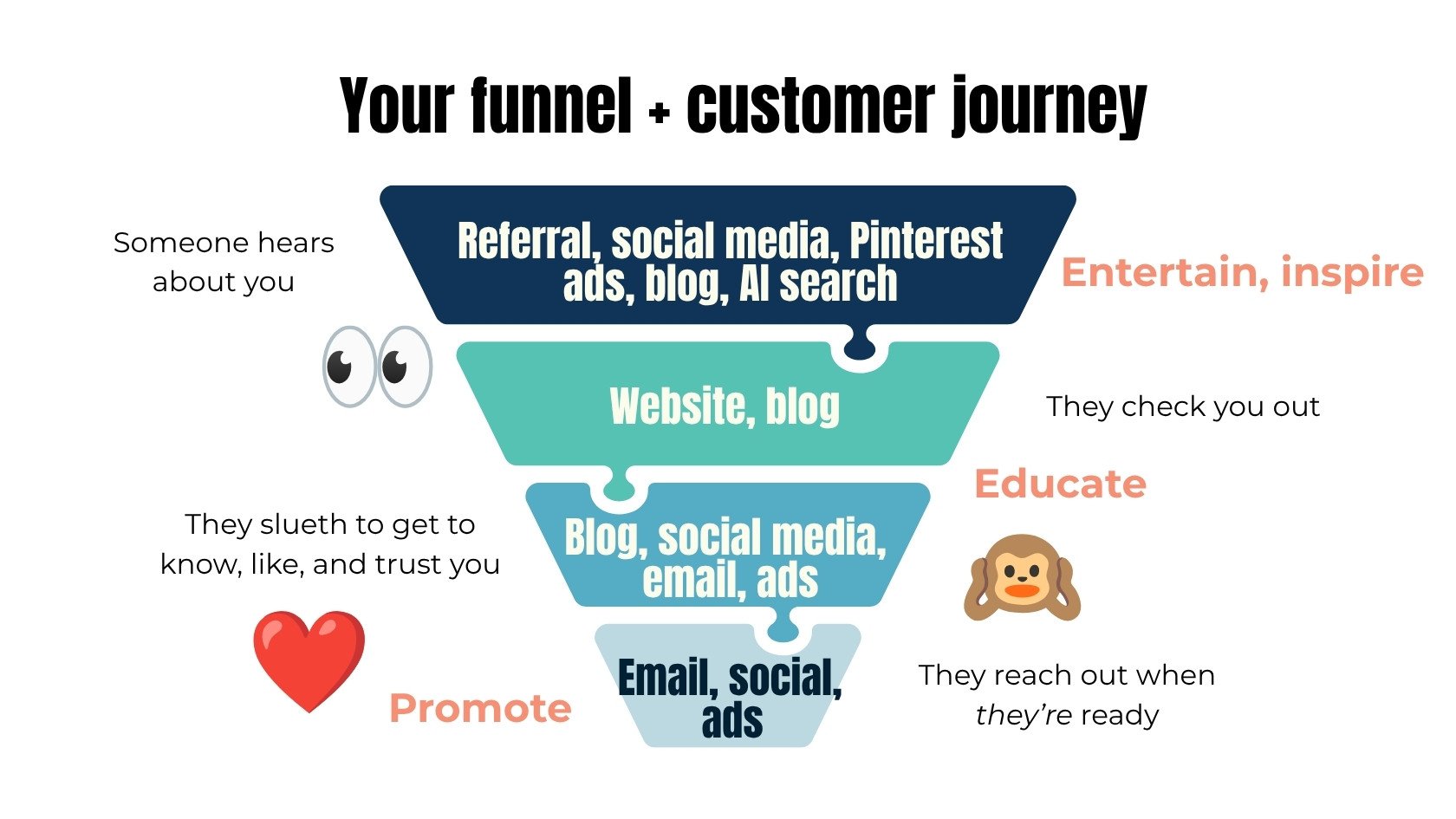
The Funnel You're Actually Working With
Every couple moves through a version of this journey before they inquire:
They realize you exist: through referrals, social, Pinterest, ads, your blog, even AI search now
They check you out: your website, your blog
They get to know, like, and trust you: blog, social, email, ads, all working together
They reach out when they're ready: email, social, ads, sealing the deal
Three jobs map onto that journey: entertain and inspire up top, educate in the middle, and promote at the bottom. Most wedding pros are doing a version of "inspire" on repeat and calling it a marketing strategy. It's one-third of the job.
What Couples Are Actually Asking vs. What We're Actually Saying
Here's the part that stings a little. While you're posting "That golden hour glow" for the fortieth time, your ideal couple is over on Reddit asking things like:
Is my budget even realistic for my area?
Is it normal to feel this overwhelmed already?
How do I find a vendor who isn't going to add stress to an already stressful process?
They're specific. They're not sugarcoated. They're real information couples need before they'll trust you enough to reach out—and a pretty caption with no substance behind it doesn't move them one inch closer to inquiring. Because it’s not actually saying something.
Building Your Booking Season Content Calendar
So how do you take "see, hear, feel" and turn it into something you can actually put on a calendar without losing your mind? Here's the four-week structure I use, mapped to the funnel:
Week 1 Realize you exist(Entertain, inspire)
See: a real wedding
Hear: a real story from the day
Feel: "I'm in the right place"
Week 2 Stuff to check out(Entertain, inspire → Educate)
See: you
Hear: your point of view
Feel: curious
Week 3 Know, like, and trust(Educate)
See: your process
Hear: something transparent
Feel: calm
Week 4 Promote
See: the next step
Hear: your availability
Feel: confident
This is the most formulaic version of it, but you can absolutely mix it up once you get the hang of it. But the underlying point stays the same: every piece of content is doing a job that moves someone toward inquiring, instead of just filling a square on the calendar.
And a lot of this can be repurposed instead of created from scratch. Think of it as Instagram content first, but plenty of it can become blog content too—one client testimonial can become an anchor post, a Reel with audio over b-roll, and a quote graphic. Same raw material, three different touch points.
Here's the thing worth remembering through all of this: you don't control when a couple is ready to book. You do control whether you've shown up when they get there.
Phase 4: The Debrief—The Part Everyone Skips
Booking season ends, you exhale, and if you're like most wedding pros, you never look back at any of it. Which means next fall you're starting from zero again instead of building on what you already learned.
Don't skip this. It's a short phase, but it's the one that helps you save time in the future and get better results:
Where did your leads actually come from?
Is there any proof or feedback about what got people to do something, not just look?
What do you feel went well? What didn't?
What would you tell future-you to do differently next year?
Booking Season Marketing Starts Now
Look, I get it—this is a lot to hold in your head on top of actually running your business. That's exactly why I built Enji's booking season campaign template: this entire timeline, mapped out and ready to work through, plus a social media scheduler, an AI copywriter trained on your brand voice, and group coaching if you want help along the way.
You don't have to build this from scratch. You just have to run it.