How I Stay Consistent With My Marketing (And You Can Too)
You know exactly what you should be doing for your marketing.
You probably have for a while. You know you should be showing up on Instagram more consistently. You know the email newsletters needs to go out. You know the blog post you've been meaning to write would actually help you get found on the internet. You know all of it.
But it doesn't get done. Not consistently anyway. Not in the steady, week-after-week way that actually turns into results.
And I'm not going to tell you that you just need to want it more. Or that small business owners who get their marketing done are simply more disciplined than everyone else. Because after more than a decade of working with small business owners and building Enji (a marketing project management tool that helps solve the “I do my own marketing” problem) I can tell you with confidence that consistency almost never comes down to how much you want it.
It comes down to how you’re trying to do the work (regardless of how much or little marketing you’re doing). And today, I’m going to show you the exact approach I use to stay consistent with my marketing—and you can too!
First, some context on how much marketing I do every month
Before I walk you through how I do my marketing consistently, I want to give you a realistic picture of what "my marketing" actually means because there are two very different buckets.
For Enji, the marketing output in a given month looks like this: 4 Instagram posts a week plus daily stories, 10 blogs (8 new, 2 updates), 12 email newsletters covering both evergreen content and active campaigns, 4 Facebook posts, 4 LinkedIn posts, 10+ Threads posts, and 8 Google Business page posts.
That is a significant amount of content. I have help executing it (more on that in a sec) and anyone trying to produce that volume would need help too. That's not a cop-out, it's just math.
For my personal brand, the output is much more manageable: 1 blog post per month, 2 email newsletters, 4 Instagram posts, and 12 LinkedIn posts. This is a volume that one person can realistically keep up with every month—and it might be really close to how much marketing you do as a small business owner.
I'm walking you through how I do both because I think there's something useful in each one, regardless of where you are right now.
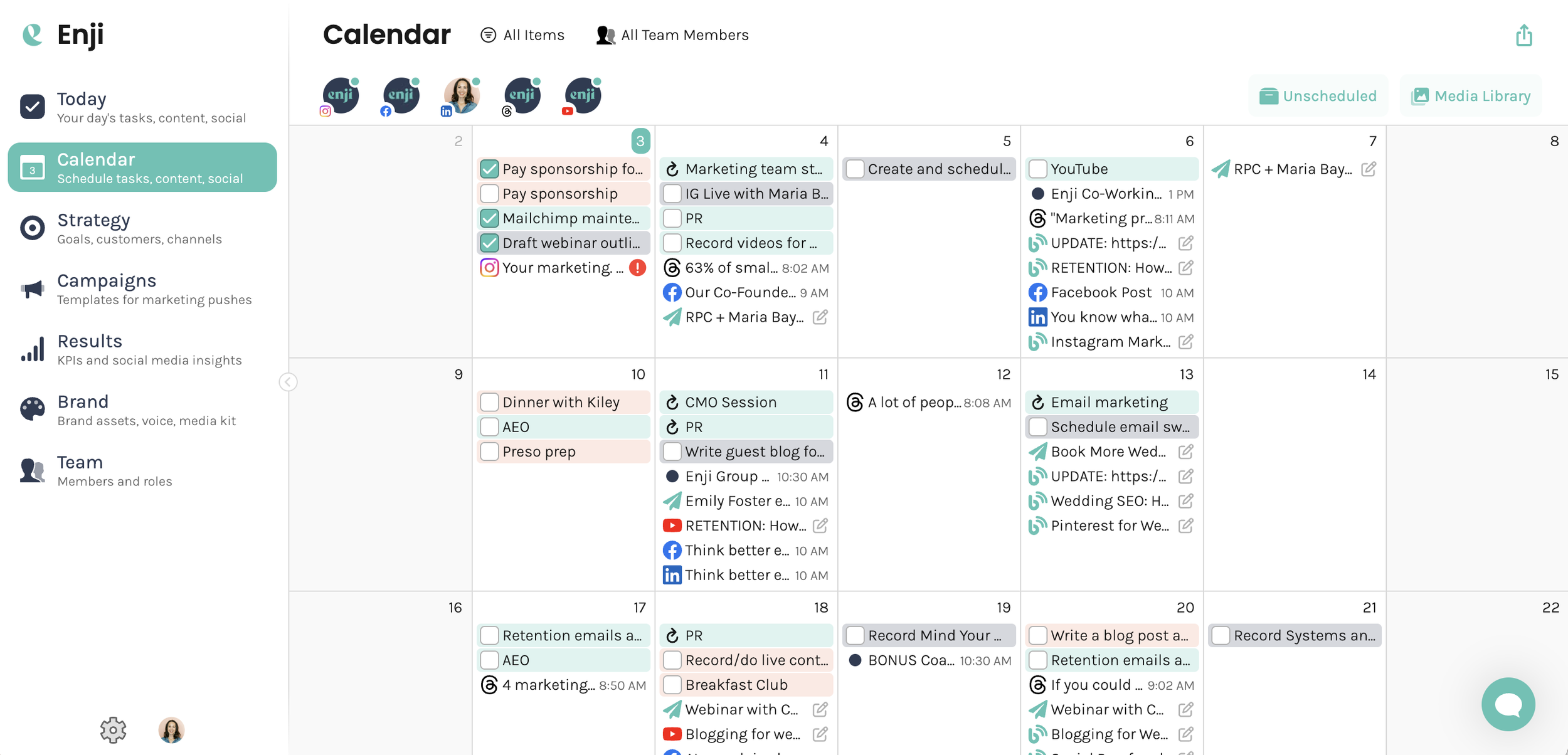
The Enji system: plan two months out, execute in batches
The most important thing I do for Enji's marketing is plan two months in advance. Not two weeks. Two months.
Because when you plan far enough ahead, you give yourself time to actually execute without the pressure of an imminent deadline stealing your best thinking. Planning for next week means you're always behind. Planning for two months from now means you have room to be intentional because you see it coming.
So once a month I sit down for a content planning session where I map out the full month that is two months out. During this session I do all the keyword research for the blogs we'll publish and outline what each post needs to cover, so that Kara from The Kara Report (our blog writer) can draft them without needing to come back to me with a hundred questions—which she typically asks me zero ::score::. I also outline what needs to be communicated on Instagram that month: any events or campaigns we're running, the overall messaging direction, what existing content we want to repurpose or promote. That outline goes to Maddie at Lavish Creative, who handles our Instagram content planning and execution at a more granular level while still hitting all the points I've identified.
This planning session is also where I map out the email newsletters for the month—both the evergreen sends and any campaign-specific emails tied to promotions or launches we have coming up.
Then the doing part happens in separate batches by channel.
I have one day a month where my main task is scheduling Facebook, LinkedIn, Threads, and Google Business page posts (channels that fall outside Maddie's scope) for a month. I use the task details section in Enji to collect content throughout the month as I come across it: a guest blog that went live, a podcast episode I was featured on, something worth sharing. When scheduling day comes, everything I need is already waiting for me in one place. I also very much use the create content from a link feature to speed writing these captions up.
Then I have one day for scheduling all the email newsletters. And one day for scheduling YouTube videos.
Everything gets planned in advance on one day. Everything gets executed in its own dedicated batch. Nothing bleeds into everything else.
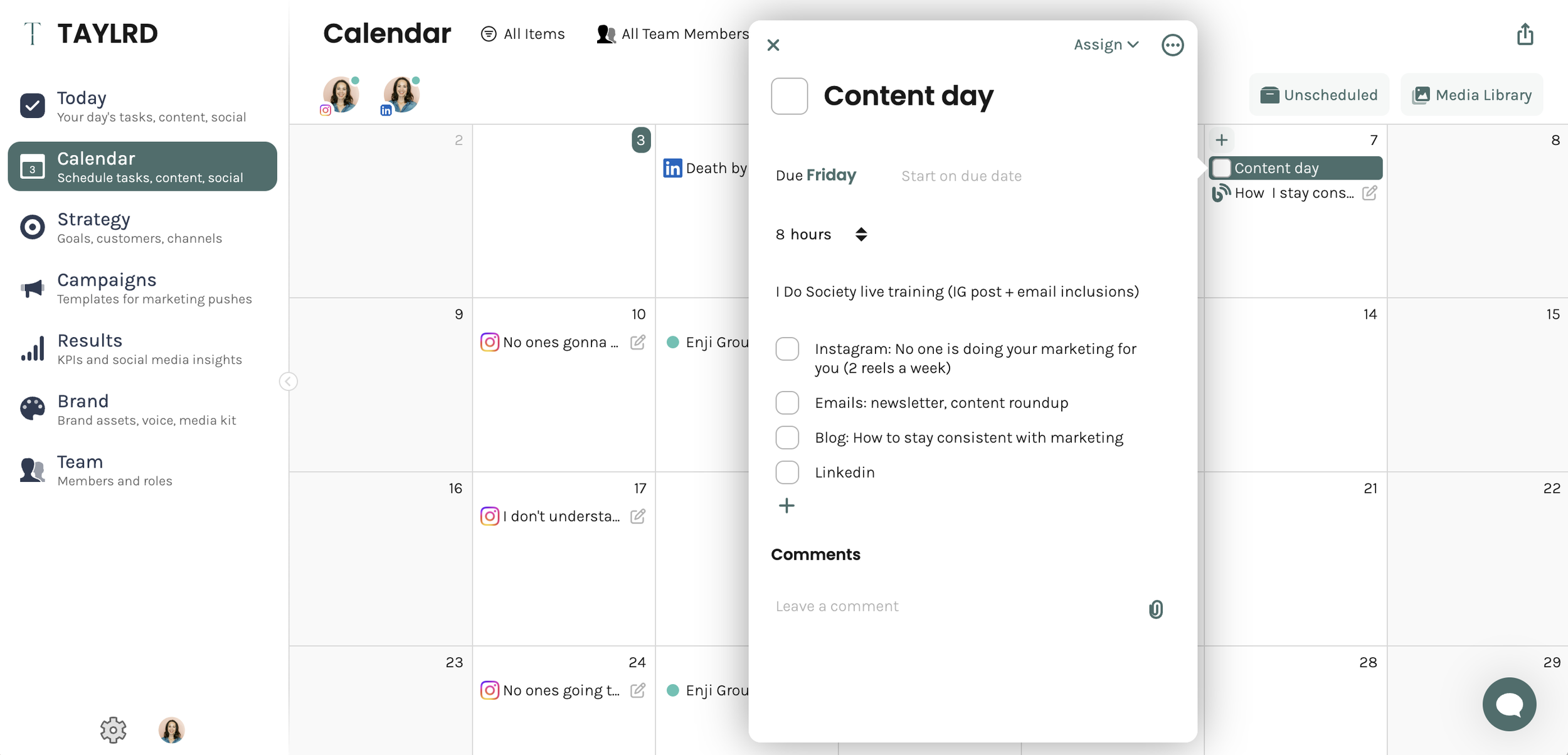
The personal brand system: one day, the whole month
For my personal brand, the system is simpler because the volume is simpler.
One day a month. Everything gets done.
I start with the blog post—one piece centered on my actual experience as a startup founder or what I'm observing in the world of small business marketing. That blog becomes the source material for most of my LinkedIn posts, so I'm not starting from scratch twelve times a month. I'm writing one thing well and then repurposing the 💩 out of it using Enji’s blog repurposing tool.
My two email newsletters follow a standard format that I don't reinvent every month. One is a real-life marketing theme or lesson (something I'm thinking about, something I've observed, something worth sharing from my own experience). The other is a content round-up that highlights what's been published on Enji's blog and channels, which doubles as cross-promotion for Enji without feeling like a pitch. Having a format means I'm never staring at a blank page wondering what the newsletter should be. I know the structure. I just have to fill it.
For Instagram, I keep a running list of empty drafts on my Enji calendar throughout the month. When I come across something I want to react to or riff on (a piece of content, a trend, an observation) I drop a link or notes into a draft. By the time my content day arrives, I have a loose collection of starting points already waiting. I fill in any gaps if needed, but the inspiration gathering happens organically, not under pressure.
The thing that actually makes me consistent with marketing
It's not the tools. It's not even the specific cadence. It's the batching of content by type—and protecting the time to actually do it.
Most people approach marketing with a vague "marketing day" or the intention to work on it a little bit every day. Both of those approaches have the same fatal flaw: scattered or unstructured time gets stolen. A Slack message from Brett about product work. A customer service ticket. An email from a collaborator that feels urgent. If I tried to do my marketing in small daily increments, it would not get done. I know this about myself. The world does not leave me alone just because I'd like it to.
What I've had to learn (and genuinely had to practice) is being okay with not answering everything in real time. On planning days and content creation days, non-urgent things wait. Not forever. Just until I'm done.
The batching by channel rather than by a generic "marketing day" is also worth calling out. Because most folks can’t block an entire day to crank. So for Enji, I don't have days where I work on YouTube, some social posts, and email newsletter. I have a day for the channels Maddie doesn't handle. A day for email. A day for video. Each batch has a clear definition of done, which means I actually finish it instead of leaving it in that painful almost-done state.
Why this is non-negotiable for me
Here's the thing I want to be honest about: I don't do this because I'm especially disciplined or because I love content planning sessions.
I do it because I have to.
The evergreen marketing (the blogs, the newsletters, the consistent social presence) is what keeps Enji visible. And I always have campaigns. Collaborations, partnerships, product launches, promotions. If I didn't have a system handling the baseline marketing, I would have no capacity for any of that. The system isn't separate from the strategic work. It's what makes the strategic work possible.
The same is true for my personal brand. The blog, the newsletters, the LinkedIn posts—these build the thought leadership that makes everything else work better. If those things only happened when I had time and felt inspired, they would happen maybe twice a year.
What this looks like for you (a small business owner doing their own marketing)
Your volume is probably not Enji's volume. And it doesn’t need it to be.
But the principle holds regardless of how much marketing you're doing: plan far enough ahead that you have time to do it, batch your content so you finish things instead of starting them, and protect the time to do it even when the world is trying to pull you somewhere else.
One planning session a month. One content creation day. Standard formats that remove the blank page problem. A place to collect ideas as they come so you're not manufacturing inspiration on demand.
It’s not glamorous. Not complicated. But ends up with consistent marketing—which, as it turns out, is the only thing that actually works.
If you want a tool built specifically to help you execute this kind of system for your own marketing, that's exactly what Enji is for. Try it at enji.co.