Why I Repositioned Enji as a "Project Management tool"
If you've ever tried to explain your business in an elevator and felt like things weren’t clicking, you know the feeling.
That was Enji's reality for 2025. We had a product people loved (once they understood it). The problem was the "once they understood it" part. Getting there took too long. Too many questions. Too much context. Sometimes a 20-minute demo just to get someone to the initial ah-ha moment that is so important for software companies.
And for a product-led company priced at the low end of the market, that's a real problem. Brett and I are not selling expensive enterprise software with a dedicated sales team and a six-week onboarding process. We need people to land on Enji’s website and get it—fast. Because if they don't, they leave. And they leave before they ever see what Enji can actually do for them.
That clarity problem is what sent me and Brett to Fletch, a B2B SaaS positioning firm, in late 2025. We'd spent the better part of a year experimenting with smaller tweaks to Enji’s messaging: copy adjustments, homepage A/B tests, different angles on the value prop. None of it moved the needle the way we needed it to. And at some point you have to stop tweaking and ask whether you're pointed in the right direction at all.
What we did with Fletch was one of the most clarifying and scary business decisions I've made. And it started with a question I thought I'd already answered: What is Enji?
Positioning isn't a marketing decision. It's a business decision.
Most founders (myself included, early on) treat positioning as a label. You look at what you built, you find the closest existing word for it, and you go with that. It feels like a naming exercise. It's not.
Where you choose to plant your flag has a lot of influence on who finds you, what you get compared to, what features you're expected to have, and what problems you're implicitly promising to solve. It shapes the customer who shows up at your door. And once you have paying customers, it gets even more complicated because their feedback starts shaping your roadmap, which means the product you launched on day one isn't the product you have two years later.
The positioning and category that fit your MVP might be quietly start being wrong for the product you actually ended up building.
This is the part that is easy to stuff away in the depths of your busy mind (because it isn’t convenient): your positioning isn't just about where you are today. It's about who you've become after real customers have used your product. And it is about where you are going from there. For Enji, the starting place was very focused on creating a marketing strategy. Then we moved into the all-in-one space as we added features. But now? We know our customers really struggle with getting their marketing done. Consistently. Week after week.
That insight changed what Enji needed to be—and it made the category question a lot more loaded than it looked on the surface.
Six options. One right answer.
When Fletch walked us through the positioning sprint (2 weeks from start to finish), they laid out six distinct bets for where Enji could play. Seeing them side by side was genuinely helpful—and a little 😳, because it showed just how many ways you can frame the same product.
Here's how I thought about each one. (And some of the conversations I had with Brett and our fractional Marketing Director, Danielle.)
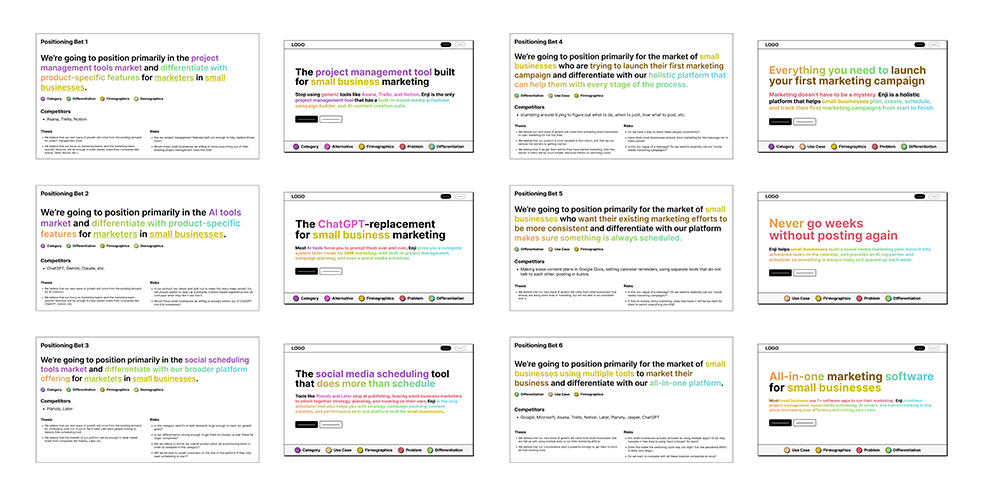
Bet 1: Project management tool for marketers in small businesses. This is where we landed, so I'll come back to it. But seeing it framed this way was the first time it felt obviously right.
Bet 2: AI tools market, differentiated with product-specific features for marketers in small businesses. This one had appeal. AI is where attention is. But competing in the AI category means your primary competitors are ChatGPT and Claude. We're a small team. We cannot develop at the pace that AI-native tools move. That's not a bet we can win.
Bet 3: Social scheduling tools market, with our broader platform as the differentiator. We actually tested this one—we built a freemium social media scheduler to create a low-friction entry point. What we learned is that this only solves a piece of our customer’s real problem. And I personally raised my hand to object to this one. As the marketer, I did not want to have to become a social media expert and talk about it 24/7.
Bet 4: Holistic marketing platform that helps small businesses at every stage of the process. The all-in-one positioning. This is where we'd been living, and it was the source of the clarity problem I described at the top. "All-in-one" is a hard sell because it requires the buyer to understand everything you do before they understand why they need you. For a product-led, low-price-point tool, that's too much work to ask of someone who just landed on your homepage and your product does 7 different things.
Bet 5: Consistency platform—helping small businesses who want to be more consistent and make sure something is always scheduled. I liked the emotional truth of this one. Consistency is exactly the problem our best users are solving with Enji. But "consistency platform" isn't a real category. There's no search term, no existing mental shelf for buyers to put it on. You'd be building the category from scratch while also building the product. That's a lot.
Bet 6: All-in-one marketing software for small businesses. A variation on Bet 4, more direct. Same fundamental problem: broad, hard to grasp quickly, crowded with competition that outspends us on every channel. Also, we felt like the SEO strategy around this was just too hard because (again) we tried it.
Why the project management category was right for Enji’s new positioning
As Brett, Danielle, and I debated things, it was very helpful to keep something the team at Fletch said. And that was picking a category was like picking what aisle your product is in at a physical store. Because when someone walks down an aisle, they have an understanding of what their problem is as well as what they imagine the solution being.
So it was an Indiana Jones moment. We had to choose wisely.
And there were mainly three reasons we picked project management for Enji’s positioning.
The product was already pretty much there. Enji isn't a massive stretch from project management—it already had tasks, planning structures, campaign frameworks. We weren't choosing a category and then rebuilding Enji to fit it. We were finally naming what we'd already built, more accurately.
The competitive set was winnable. Asana and Notion are our primary competitors in this frame. That sounds scary until you look at what they are: blank-slate, general-purpose tools. They're not built for small businesses. Enji is. That specificity is a real differentiator, and it's one we can actually defend.
It made Enji click faster. This is the one that sealed it. "Project management for small business marketing" is a sentence someone can process in about three seconds. They know what project management is. They know what small business marketing is. The combination tells them exactly what Enji does without a 20-minute demo. For a product that needs to sell itself, that's not a nice-to-have. It's everything.
Where it can go wrong and why we're okay with that
I want to be honest about the risk, because it's real. Repositioning is not something to take lightly.
Project management is a broad category. Some people who find us will be looking for a blank-slate tool—a customizable workspace they can shape into anything. That's not Enji. We're opinionated. We're built specifically for small business marketing. Those people will bounce, and that's fine, but we'll spend some time and money acquiring them before we find out.
That's a tradeoff we weighed consciously. And when we put it next to the cost of the alternative —continuing to explain Enji in paragraphs instead of sentences, continuing to lose people before they ever reached the ah-ha moment—the risk of some wrong-fit buyers felt manageable.
The right-fit buyer finding us faster is worth more than the wrong-fit buyer finding us at all.
What the process of repositioning actually taught me
The biggest thing I took away from working through this with Fletch wasn't the category we chose. It was the discipline of actually choosing.
It made me realize that I had fallen a bit prey to trying to be everything to everyone (even though it wasn’t to a huge degree). The result was that no one understood how Enji would solve their problem. Positioning is an act of exclusion as much as inclusion—and that's uncomfortable when you're a small company that wants every customer you can get.
But here's what I've learned after three years of building Enji: the customers who stay, who get value, who tell other people about the product, they're the ones who felt like Enji was built for them. Not for everyone. For them.
If you're a founder wrestling with your category, or a small business owner trying to figure out how to position your own services in a crowded market, the question worth sitting with isn't "what's the broadest true thing I can say about what I do?" It's "what's the most specific true thing—and who does that resonate with immediately?"
That's the person worth building for.
Enji is the only project management tool that brings planning and doing your marketing together, helping you write, schedule, post, and track all in one place. If that sounds like what you've been looking for, try it at enji.co.